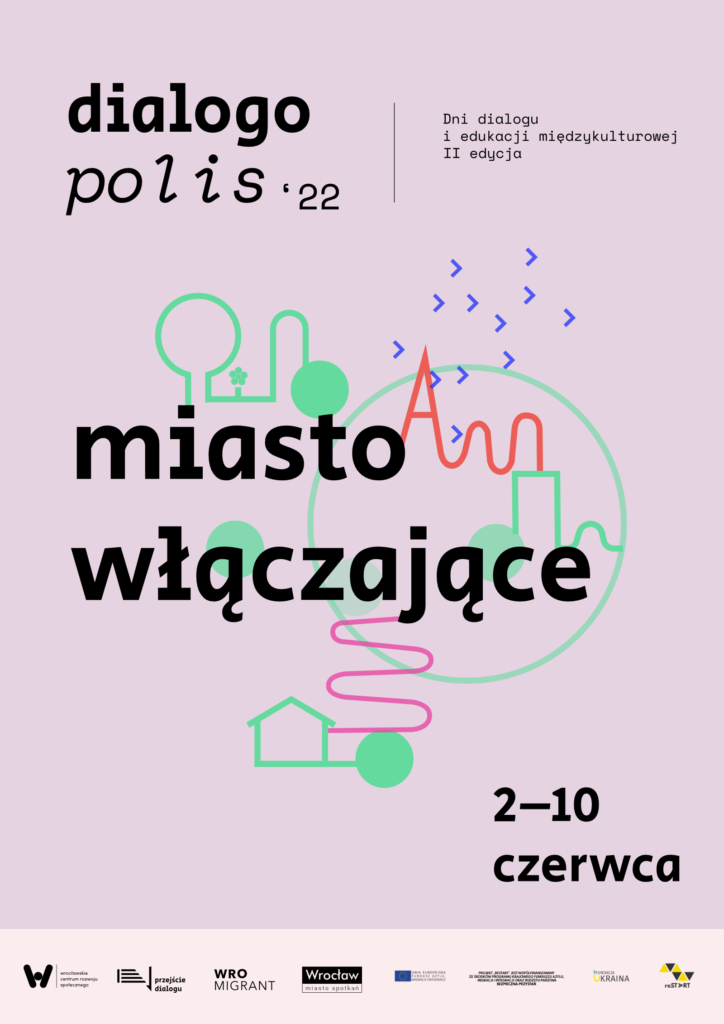
Dialogopolis ’22: An Inclusive City.
2nd edition of the Days of Dialogue and Intercultural Education.
An inclusive city – what does that mean?
One that shapes its residents?
Or one that is shaped by them?
Dialogopolis ’22 is a space for sharing experiences between local government, institutions, NGOs and volunteers.
Dialogopolis ’22 Days of Dialogue and Intercultural Education
– the idea
A modern city is a fabric woven from diverse communities, worldviews and perspectives. It is home to many social, national, ethnic and age groups.
Year by year, Wrocław is becoming an increasingly diverse place. This makes us happy and excited, because we know that this diversity holds enormous strength and potential for everyone who lives here.
Every resident of Wrocław grows in intercultural skills as the Wrocław community changes.
An inclusive city – values
An inclusive city cares for its new residents.
An inclusive city supports its citizens in social action.
It provides useful tools and guidance to public offices, schools and neighbourhoods.
An inclusive city looks after its resources.
How can we act – helping ourselves and others – to make Wrocław such a city?
Dialogopolis ’22 An Inclusive City
– programme
From 2 to 10 June, Dialogopolis ’22 will take place at various locations across Wrocław.
We will meet representatives of local government, NGOs and volunteer groups to discuss together good practices for involving residents in the life of the city.
The starting point for these discussions is the challenges that the war in Ukraine poses for the local community. In particular, we want a dialogue that takes into account the perspective of migrants and of the community involved in relief efforts.
We have planned round-table meetings, public consultations, debates and workshops for you.
2 June
A Welcoming City
What has happened in Wrocław’s public offices, institutions and NGOs since the outbreak of the war in Ukraine? A summary of the work of institutions, organisations and volunteers.
Over the past months, we have witnessed an extraordinary mobilisation and commitment of Wrocław residents to helping people fleeing Ukraine. Many challenges still lie ahead of us. Behind us are many shared achievements. Long-term solutions cannot be developed without reflecting on what has happened so far. That is why we are dedicating the opening meeting of Dialogopolis ’22 to presenting a summary of the work of volunteers, non-governmental organisations, and municipal institutions and offices.
Time: 10.30-12.00
Venue: Czasoprzestrzeń, ul. Tramwajowa 1-3
What should local integration policy look like?
A round-table meeting as part of the public consultations. An exchange of knowledge and experience between local government, NGOs, Local Activity Centres (CALs) and volunteers.
A city that receives refugees should support the integration of newcomers with the local community. The war in Ukraine presents Wrocław with an enormous range of challenges that require committed cooperation between local actors. Together with representatives of institutions, NGOs, the migrant and refugee communities, and the city’s residents, we will discuss key areas of support. What are the strengths of the work being done in Wrocław, and what is currently missing? The public consultations are a cross-sector dialogue that approaches local integration policy from many perspectives.
Time: 12.30-14.30
Venue: Czasoprzestrzeń, ul. Tramwajowa 1-3
Round-table topics:
- intercultural education among children and young people – we will talk about which activities are most effective in the integration process and which need support. We will ask what can help the school community and what hinders integration.
Moderator: Iwona Frydryszak
- volunteering of tomorrow – how can we build on the unprecedented commitment of volunteers to supporting our guests from Ukraine? We will consider how to turn this exceptional activity into long-term engagement. We will also try to answer the question of what volunteers, non-governmental organisations, institutions and refugees need in order to build local civil society together effectively and consistently.
Moderator: Joanna Wajda
- housing and the labour market – what measures can improve the process of finding a place to live and the organisation of collective accommodation and residential rentals? At this table we will also discuss employment as part of new residents’ path to independence, as well as the social economy.
Moderator: Mirosława Hamera
- local community and neighbourhood – how can we create welcoming conditions for people to meet? How can we engage people in local activity in their neighbourhood communities by co-creating cultural, sporting, educational, social and other activities? These are the main themes of the planned discussion.
Moderator: Maria Zięba
- effective resolution of intercultural conflicts – we will talk about what helps to prevent them, how to resolve them, which activities should be supported by the city, and who should be involved in this process.
Moderator: Dorota Whitten
- social participation – how can refugees and migrants be effectively involved in local social processes? The conversation will focus on the rights and responsibilities of community members and on local participation.
Moderator: Tadeusz Mincer
Local migration policies
An expert debate on local migration and integration policies, preceded by a summary of the public consultations.
Why do we need local migration policies? Should Polish cities work on a common model of policies and their implementation? How can we pursue systemic change that takes into account the situation of all the city’s residents? How can integration policies be developed during a humanitarian crisis? Experts will try to answer these and other questions during the debate on local migration policies.
Time: 15.30-17.30
Venue: Czasoprzestrzeń, ul. Tramwajowa 1-3
Moderator of the public consultation summary: Krzysztof Ziental
Debate moderator: Anna Gmiterek-Zabłocka (TOK FM)
Debate participants:
- Prof. Patrycja Matusz of the University of Wrocław,
- Dr Karolina Łukasiewicz of the Centre of Migration Research,
- Katarzyna Komar-Macyńska of the Ukrainian House in Przemyśl,
- Tatiana Iwanow of the For Your Freedom and Ours Foundation,
- Anna Dąbrowska of the Homo Faber Association in Lublin,
- Anna Szadkowska-Ciężka, Deputy Director of the Social Participation Office in Lublin,
- Jacek Pluta, Deputy Director of the Department of Social Affairs, Wrocław City Hall.
The debate will be streamed on the Facebook pages of the Wrocław Centre for Social Development, Przejście Dialogu (Passage of Dialogue) and the Nomada Association.
Polish Cinema for Beginners #16 – “Newcomers”, ep. 4
Screening of the film “Beyond Words” (“Między Słowami”, directed by Urszula Antoniak) with English subtitles. Open-air cinema in Staszic Park.
Polish Cinema for Beginners is a film programme aimed primarily at non-Polish-speaking audiences – the films are screened with English subtitles, and the accompanying discussions are also held in English. Entitled “NEWCOMERS”, the 16th season of the series is devoted to the stories Polish cinema tells about newcomers: both foreigners arriving in Poland and Poles seeking a better life abroad.
Time: 21.30-23.00
Venue: Stanisław Staszic Park, ECoC container
3 June
Conflict management – intercultural mediation
A workshop on how to recognise intercultural conflicts and how to prevent them.
What are the areas of intercultural conflict? How can conflicts be prevented through cooperation between the parties and relationship-building? During the workshop, participants will get to know mediation and conflict management tools and learn how to use them. The practical part will be preceded by a short introduction to the theory of intercultural conflict.
Facilitators: Dorota Whitten, Maja Zabokrzycka, Joanna Wajda (Dom Pokoju Foundation)
Time: 16.00-19.00
Venue: Infopunkt Łokietka 5, ul. Władysława Łokietka 5/1
Intercultural communication in times of social challenge
A workshop on effective communication in an intercultural environment. Ways of looking after yourself and communicating well with others, especially in difficult times.
How can we increase our personal effectiveness, simplify relationships and make life easier for ourselves and others? What kind of rest will help us truly recover after hard times? What inspires each of us, and what drains our energy? Each of us interprets and responds to reality differently. By exploring the mechanisms and thinking styles of the FRIS® Model (Facts–Relationships–Ideas–Structures), we will learn how to look after our well-being when dealing with others.
Facilitator: Swietlana Listopadzka – certified FRIS trainer, coach and intercultural competence trainer. An entrepreneur with 20 years of experience.
Time: 14.00-18.00
Venue: EWST, ul. św. Jadwigi 12, 50-266 Wrocław
3-4 June
Living Library
15 years of conversations between Wrocław residents and Living Books – people from marginalised groups.
The Wrocław Living Library has been hosting conversations about local diversity for 15 years. Every visitor will be able to borrow a Living Book for a conversation – a representative of a cultural, ethnic, religious, social or professional minority who faces stereotypes, prejudice and exclusion. In this edition you will be able to talk to people such as an Atheist, a Refugee, a Ukrainian Woman, a Mother of a Child with a Disability, a Queer Person and others. The aim of the project is to raise Wrocław residents’ awareness and knowledge of minorities and of the problems these people face living in our city.
Organisers: Diversja Association, Municipal Public Library – Mediateka, Branch No. 58
The event is part of WroPRIDE and is held in cooperation with Kultura Równości.
Introductions of the Living Books and more about the event: www.facebook.com/events/982260172491340
Time: 12.00-20.00
Venue: Mediateka, plac Teatralny 5
Open event – no registration required.
6 June
On the self-organisation of migrants and refugees
How are the Ukrainian and Belarusian communities helping newcomers? In the debate: the role of self-organisation among new residents and their part in building the local community.
The Ukrainian community itself plays an active role in organising help from Wrocław residents for refugees from Ukraine. Similarly, for years the Belarusian community has been organising itself at grassroots level to support successive groups of people fleeing persecution in Belarus. What relief initiatives have migrant communities launched? How do they establish cooperation and partnerships with local government and non-governmental organisations? We will find out in a conversation about their experiences.
Moderator: Daria Mymka – member of the Intercultural Dialogue Team at the Wrocław Centre for Social Development, consultant at WroMigrant, the municipal information point for migrants, co-founder of the “Ptach” Foundation, which supports children affected by the war in Ukraine, and co-founder of “English to the East”, a charitable educational programme for children from Ukraine. She has lived in Poland for over 10 years.
Guests:
- Artur Kviatsinski – one of the founders of the Belarusian Solidarity Union Association in Wrocław. Technical director of a division of an international packaging company. Member of the Belarusian Business Angels Association. He has lived in Poland for 14 years.
- Ina Shulha – entrepreneur and volunteer. After the protests broke out in Belarus, she became actively involved in relief work. She initiated charity auctions whose proceeds went towards renting flats and providing material aid for people fleeing Belarus. She is now involved in helping friends from Ukraine. She has lived in Poland for 13 years.
- Olena Vorovchenko – has lived in Poland for the last 6 years and works in the IT sector; co-founder of the “Ptach” Foundation, which helps children affected by the war in Ukraine. She has been working on behalf of Ukraine for years. She joins forces with other organisations – at the Ukraina Foundation she heads the Refugee Support Department.
- Halina Czekanowska runs her own tailoring workshop and came up with the idea of a charity pierogi-making campaign, with the proceeds from sales going to the armed forces of Ukraine. She co-organises charity festivals for Ukraine and has been active in the local Ukrainian community for years. She came to Wrocław 11 years ago.
Time: 18.00-20.00
Venue: Przejście Dialogu, ul. Świdnicka 19
7 June
How do you set up your own business?
Practical training for migrants planning to start their own business in Poland.
Are you planning to start a business in Poland and looking for advice on where to begin? We have planned a training session that will explain the process of setting up your own company step by step. What types of business can foreigners set up? What formalities need to be completed, and how do you apply for registration in CEIDG (the Central Register and Information on Economic Activity)? The training will be held in Polish, with a presentation and with participants’ questions interpreted into Ukrainian.
The training will be delivered by Bożena Bronowicka – Director of the Civic Affairs Department, Wrocław City Hall – and Iwona Lubka and Ewa Ruda – specialists from the Economic Development Office of Wrocław City Hall with many years of experience working at the Business Information Point.
Language of the meeting: Polish / Ukrainian
Time: 12.00-14.00
Venue: Infopunkt Łokietka 5, ul. Władysława Łokietka 5/1
Business for a fresh start – stories of Wrocław entrepreneurs
In this debate, we give the floor to migrant entrepreneurs who started their businesses in Wrocław.
What is it like to be a migrant and run a business in Poland? Wrocław residents who came here from different parts of the world and opened businesses in a new country will talk about their experiences, observations and inspirations. Migrant entrepreneurs will tell the stories of their own journeys and share their diverse perspectives on running a company. We will talk about the challenges, difficulties and bureaucratic hurdles that entrepreneurs from various countries of origin face in Poland.
Time: 18.00-20.00
Venue: Przejście Dialogu, ul. Świdnicka 19
8 June
Humanitarian aid at the Polish-Belarusian border
The humanitarian crisis at the Polish-Belarusian border is still ongoing. For more than a hundred days it has been unfolding in the shadow of the war in Ukraine and the exodus of nearly 4 million people from that country. This is a hundred times more than the number of people travelling the route through the Białowieża Forest, the oldest forest in Europe, which refugees call “the jungle”. Since July 2021, tens of thousands of migrants and refugees have attempted to cross the border from Belarus into Poland, Lithuania and Latvia. The policy pursued by the Polish authorities makes it impossible to provide assistance to refugees or to monitor the actions of the uniformed services in the border zone.
During the meeting, we will discuss the social movement that, in response to the humanitarian and human rights crisis at the border and in detention centres for migrants, is organising and developing grassroots humanitarian aid.
We will look at segregation and the different standards for “receiving” refugees into our country. We will also point out that people who help at one border are called heroes, while at the other, several hundred kilometres to the north, they face arrest and imprisonment. Finally, we will try to answer the question of whether, after such experiences, in a state that tramples on human rights, there is still a chance for dialogue between its citizens and the services under its authority.
Guests:
Aleksandra Chrzanowska – graduate in cultural studies from the University of Warsaw. Since 2006 she has worked with refugees as an integration/intercultural adviser at the Association for Legal Intervention (SIP), and since 2008 she has been a member of the SIP Management Board. Author of publications on refugee integration and multiculturalism. Winner of the 8th edition (2015) of the J. Zimowski Award, given for work on behalf of social groups in extreme situations, in particular migrants and refugees. Since August 2021 she has been involved in intervention work on the Polish-Belarusian border as part of Grupa Granica.
Agata Ferenc – ethnologist and traveller. As a development aid worker in Palestine and Sri Lanka, she spent several years living in an intercultural environment, where cultures meet. She has worked with many Wrocław non-governmental organisations. Assistant and cultural interpreter for Roma families from Romania living in Poland. In 2015 she took part in aid missions to refugee camps in the Balkans. Social activist and human rights activist.
Weronika Mazurek – graduate in cultural studies from the University of Wrocław and in architecture and urban planning from Wrocław University of Science and Technology. She has been involved in climate activism for 4 years, and since August 2021 she has been engaged in intervention work on the Polish-Belarusian border as part of Grupa Granica. Since April this year she has been supporting the Polska Gościnność Foundation in day-to-day communication with refugees seeking various kinds of help.
The meeting will be moderated by Maciej Mandelt of the Nomada Association.
During the meeting at Przejście Dialogu, you will be able to watch video footage of relief operations in the border area.
Time: 18.00-20.00
Venue: Przejście Dialogu, ul. Świdnicka 19
9 June
Building an intercultural school
Specialist intercultural education workshops.
Faced with the challenge of receiving refugees, the school as we have known it may no longer be enough. So what if we rearranged the building blocks? During the workshop, we will try to look at the school situation from a different perspective. To rearrange the blocks, we will use creative workshop methods (supported by wooden KAPLA blocks) and have a practical, down-to-earth conversation about what to do, and how, in times of crisis.
Facilitators: Kamila Kamińska-Sztark, Hanna Achremowicz – PhD in the humanities, Association for Critical Education
Time: 9.00-11.00
Venue: Przestrzeń Trzeciego Wieku, pl. Solidarności 1/3/5
Let’s talk about the multicultural school
Dialogue session – a conversation about schools’ needs in managing diversity, about good practices and about the areas in which schools need support.
The meeting aims to raise awareness of the basic issues and tools that help prevent interpersonal conflicts. What does working with newly arrived pupils involve? How does diversity affect creativity? Which competences matter in building a close-knit, cooperative team? How can we look after good relationships within a group? The discussion will draw on examples of peer mediation, methods of resolving conflicts in schools and non-violent communication.
Facilitators: Dorota Whitten, Joanna Wajda – Dom Pokoju Foundation
Time: 11.15-13.15
Venue: Przestrzeń Trzeciego Wieku, pl. Solidarności 1/3/5
The intercultural school – a place of challenges and benefits for all
Specialist intercultural education workshops.
The workshop will present ways of creating an intercultural space at school – ideas for the participation of all pupils and for making their presence visible in the school community. We will compare the opportunities and benefits offered by preparatory classes and mixed classes. We will discuss ready-made lesson plans and good practices from other schools and countries.
Facilitator: Małgorzata Czaicka-Moryń, Freya Foundation, High School No. XV
Time: 13.30-15.30
Venue: Przestrzeń Trzeciego Wieku, pl. Solidarności 1/3/5
Psychological first aid
What should you do to help, and what should you avoid so as not to cause harm? A psychological first aid workshop.
Each and every one of us can provide psychological first aid to a person who has experienced a crisis – it does not require training in psychology. Nevertheless, awareness of the principles of providing psychological support is extremely important. It safeguards respect for the dignity, culture and capabilities of those in need. The workshop is an introduction to providing psychological first aid in a way that is safe both for those offering support and for those receiving it.
Facilitator: Urszula Andruszko – child and adolescent psychologist, graduate in psychology from the University of Wrocław, currently working at Mentali – Centre for Psychological Development and Support. She works with the Kalejdoskop Kultur Foundation to build a support system for people affected by the war in Ukraine.
Time: 16.30-18.30
Venue: Municipal Public Library, Grafit branch, ul. Namysłowska 8
10 June
Activities that include local communities – from idea to implementation of intercultural neighbourhood initiatives
Workshops on planning and organising local integration events that take into account the diversity of participants (ethnic, national, linguistic, social and other).
How can you effectively plan local events for residents so as to actively involve them in an initiative, regardless of their language or country of origin? We will look at examples of many initiatives, distinguishing basic errors and mistakes from good practices that contribute to a friendly, non-exclusionary atmosphere. We will practise thinking about neighbourhood events in a way that takes into account the diversity of their audiences and has a real impact on local ties, cooperation and integration.
Facilitators: Anka Bieliz and Aleksandra Stachura (Microgrants / Wrocław Institute of Culture)
Anka Bieliz – cultural animator and manager, graduate in sociology, art history, cultural studies and communication design from the University of Wrocław. Chief Coordinator of the Microgrants Programme at the Wrocław Institute of Culture and Programme Director of MIASTOmovie, a festival about the city and architecture.
Aleksandra Stachura – graduate in business language and in cultural studies, specialising in cultural animation, from the University of Opole. Since 2018 she has co-coordinated the city-wide Microgrants project co-organisation programme at the Wrocław Institute of Culture (previously at Strefa Kultury Wrocław). She is Vice-President of the Go’n’act Foundation, where she also works as an educator and coordinator of intercultural integration projects.
Time: 10.00-14.00
Venue: Municipal Public Library at the PKP railway station, ul. Piłsudskiego 105
What makes a city intercultural? Wrocław as a member of the ICC Programme
In 2021, Wrocław joined the prestigious Council of Europe Intercultural Cities Programme (ICC). During the session, we will give the floor to representatives of the Council of Europe, who will introduce participants to the vision, strategy and working methods of the Intercultural Cities network. Representatives of ICC member cities will share their stories and the benefits they have gained from taking part in the programme. The closing meeting of Dialogopolis ’22 is also a space for dialogue about the opportunities and challenges facing Wrocław as an intercultural city.
Moderator: Dorota Kozak-Rybska, WCRS Intercultural Dialogue Team.
Guests:
- Ivana d’Alessandro – Council of Europe
- Claudia Emmanuel Laredo – City of Bilbao
- Anna Szadkowska-Ciężka, Deputy Director of the Social Participation Office in Lublin,
- Marta Majchrzak, Deputy Director for Cross-Sector Projects, Wrocław Centre for Social Development
Time: 11.00-12.30
Venue: online meeting
Registration for Dialogopolis ’22 events
Registration forms for individual events can be found next to their descriptions in the programme.
The number of places at meetings, debates and workshops is limited – places are allocated on a first-come, first-served basis.
Join the event on Facebook,
so you don’t miss any new information about Dialogopolis ’22!
Organisers
The project is organised by the Intercultural Dialogue Team of the Wrocław Centre for Social Development.
Dialogopolis is held as part of the ReSTART project, co-financed by the National Programme of the Asylum, Migration and Integration Fund (FAMI) and the state budget.