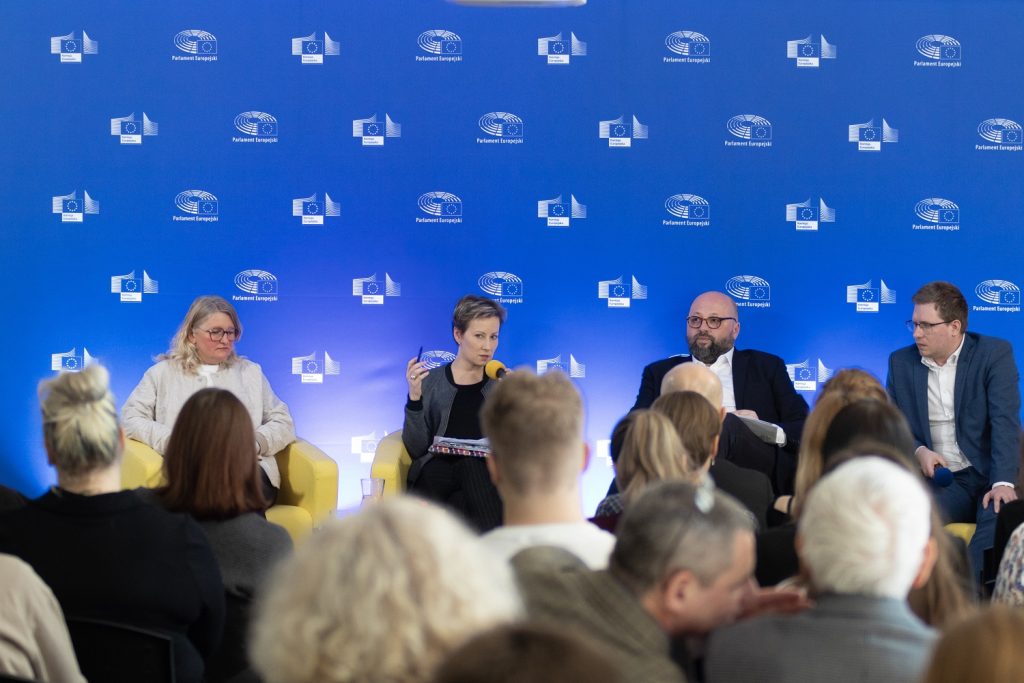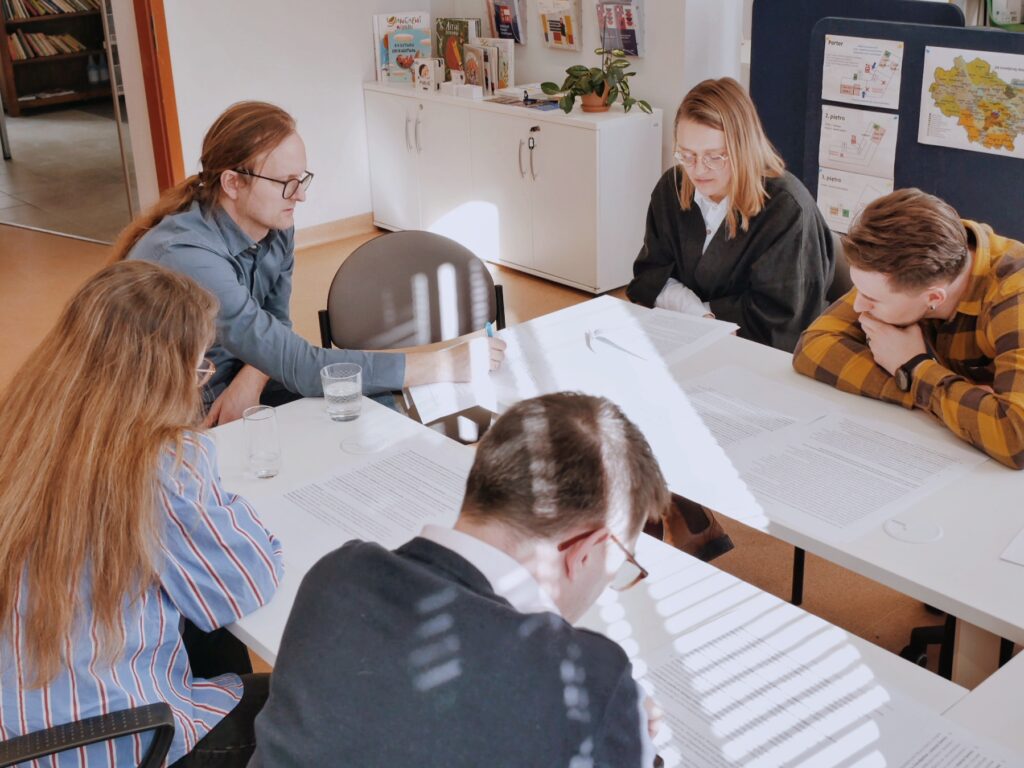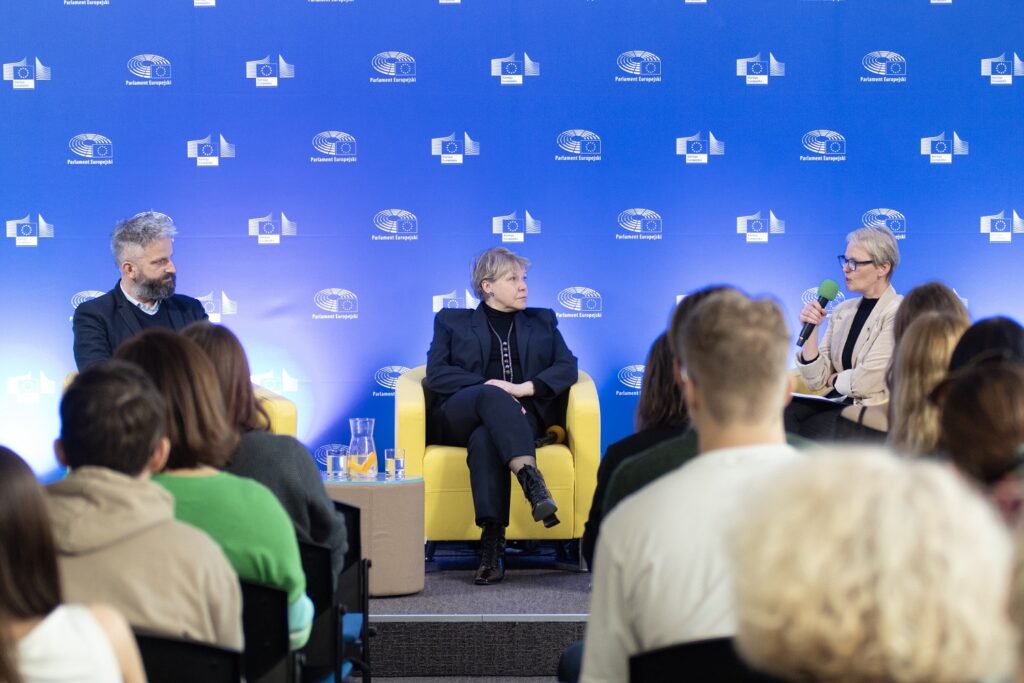
Together with representatives of European, national and local institutions, civil society organisations and academia, we considered how to develop and implement effective migration and integration strategies. Two debates on this topic took place as part of the event With a View to Multilevel Migration Management on 26 March 2024 at the House of Europe in Wrocław.
The event “With a View to Multilevel Migration Management” was organised by the Regional Representation of the European Commission and the European Parliament Office in Wrocław in partnership with Stowarzyszenie Nomada, the Laboratory of Migration Policies of Cities and Regions, the Centre of Migration Research at the University of Warsaw and the Migration Consortium. According to the organisers, the aim of the event was strategic, multilevel reflection on managing processes in the area of migration and social cohesion.
The first panel, moderated by Magdalena Nazimek-Rakoczy, focused on both national and local solutions to support migrants. Bartłomiej Potocki, Director of the Social Integration Department at the Ministry of Family, Labour and Social Policy, presented the initial assumptions of Poland’s forthcoming migration policy and shared the vision of creating a network of Centres for the Integration of Foreigners, which are to be set up not only in the largest metropolitan areas but also in county towns with large numbers of migrants and refugees. Mateusz Płoskonka, Deputy Director of the Department of Social Policy and Health at Kraków City Hall, shared his experience of running the Intercultural Centre and other initiatives undertaken in Kraków. He pointed to the advantages of having a single place where any migrant can deal with all their matters, as well as the need for an institution whose staff speak many languages. The debate also featured an academic perspective: Dr Marta Pachocka, an expert of the Team Europe Direct network and a lecturer at the SGH Warsaw School of Economics, talked about the European Union’s activities concerning migrants and refugees and about the importance of integration as a key component of national and international migration policy. Non-governmental organisations were represented by Myroslava Keryk, President of Fundacja Ukraiński Dom. Ms Keryk focused primarily on opportunities for migrants and refugees to participate in public life, noting that a very important aspect should be the possibility of obtaining voting rights, following the models used in some European countries.
The second panel, moderated by Alina Szeptycka, was devoted to local migration policies and education. Karolina Łukasiewicz, a specialist from the Centre of Migration Research, talked about different policy models introduced in Poland and around the world. She pointed to successful policies that led to the integration of the host society and migrants, as well as practices that did not work in large urban areas. Bartłomiej Świerczewski, Director of the Social Affairs Department of Wrocław City Hall, briefly summarised the Wrocław Strategy for Intercultural Dialogue 2018–2022 and presented the main assumptions of the new strategic document, noting that it is being prepared by specialists on the basis of a review of the previous document and of local and national research findings on migration. The last topic addressed during the panel was education, or more precisely anti-discrimination education. The Lower Silesian Education Superintendent, Ewa Skrzywanek, talked about educational experience to date and plans for the coming years, which envisage greater involvement of non-governmental organisations in schools.
We would like to thank the organisers for inviting us to this important event, where we were able to examine together the idea of multilevel migration management from different perspectives – local (municipal), national and European.