We invite you to the next networking meeting, taking place in April as part of the “Together on Interculturality” series. The topic of the meeting will be knowledge – both formal knowledge gathered by various institutions and grassroots knowledge created in local communities with the involvement of migrants and refugees.
When and where?
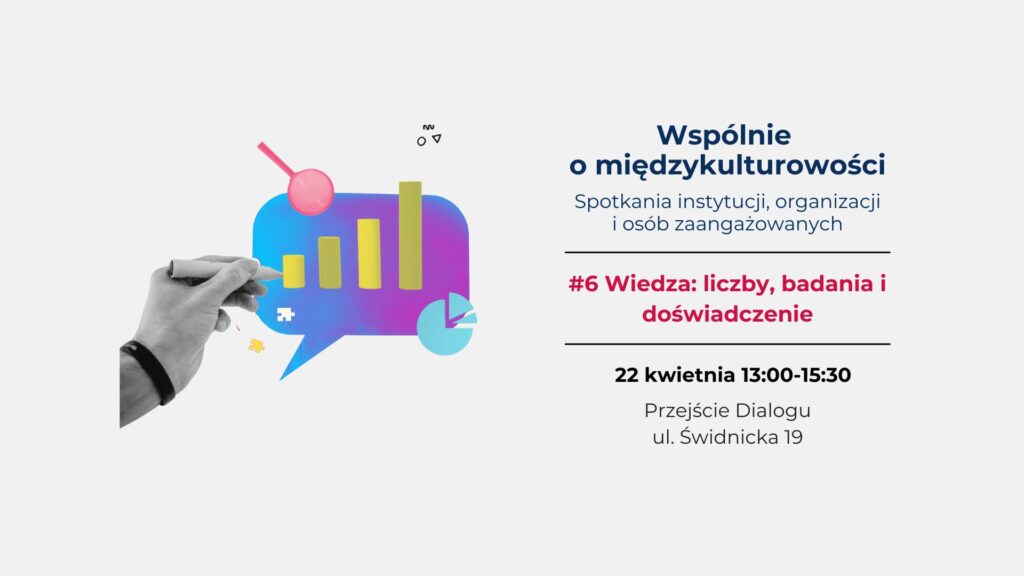
We will meet in person on Monday 22 April (13:00–15:30) at Przejście Dialogu (Passage of Dialogue, ul. Świdnicka 19).
What will happen at the meeting?
At the meeting, we will present estimates of the number of Wrocław residents, including migrants and refugees, based on municipal statistics. An expert from the Statistical Office in Wrocław will explain where and how to look for statistical data. We will hear a presentation summarising the results of the quantitative and qualitative study “Living Conditions and Quality of Life in Wrocław – the City’s New Residents”, and we will also talk about local knowledge co-created by migrants in cooperation with non-governmental organisations. Together, we will consider how to create a space and tools for sharing knowledge.
Agenda
- How many residents does Wrocław have? Why do numbers matter in the context of migration? Jacek Pluta, Director of the Department of Social Affairs, Wrocław City Hall
- How many migrants and refugees live in Wrocław? Marta Majchrzak, Dr Albert Miściorak, WCRS
- Where to look for data and how to use it? Dr Elżbieta Stańczyk, Statistical Office in Wrocław, and Dr Leszek Cybulski, Polish Statistical Society
- Summary of the study “Living Conditions and Quality of Life in Wrocław – the City’s New Residents”, Prof. Kamilla Dolińska and Prof. Julita Makaro, University of Wrocław
- Local knowledge – on knowledge co-created by migrants, Dr Kamila Kamińska (Critical Education Association), Joanna Wyrwa, Tadeusz Mincer (FEPS)
- Discussion, conclusions, information from participants
Register for the meeting using the registration form on the Przejście Dialogu website:
The meeting is organised by the Wrocław Centre for Social Development together with its partners: the Foundation for European Studies (FEPS) and the Lower Silesian Federation of Non-Governmental Organisations (DFOP).